

Gourishankar Soni
is a multidisciplinary visual artist whose works draw from architectural memory, cultural symbolism, and the human condition. His art has been exhibited widely across India in cities such as Delhi, Mumbai, and Jaipur, and internationally in Hungary and several regions of Africa.
He is the recipient of awards from prestigious institutions including Lalit Kala Akademi, All India Fine Arts and Crafts Society, and Rajasthan Lalit Kala Akademi. His works are part of numerous public and private collections in India and abroad.
is a multidisciplinary visual artist whose works draw from architectural memory, cultural symbolism, and the human condition. His art has been exhibited widely across India in cities such as Delhi, Mumbai, and Jaipur, and internationally in Hungary and several regions of Africa.
He is the recipient of awards from prestigious institutions including Lalit Kala Akademi, All India Fine Arts and Crafts Society, and Rajasthan Lalit Kala Akademi. His works are part of numerous public and private collections in India and abroad.
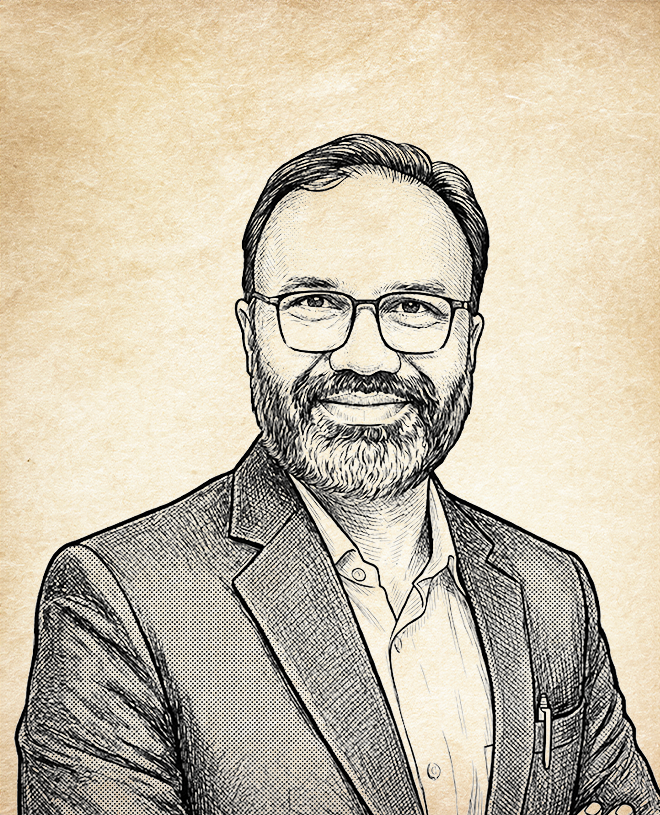
Gourishankar Soni
Jaipur | Multidisciplinary visual artist
Journey
Born in 1980 in Shrimadhopur, Sikar district of Rajasthan, Gourishankar Soni completed his Diploma in Drawing and Painting from Rajasthan School of Art, Jaipur in 2000. He later earned his M.F.A. in Painting from the Faculty of Fine Arts, Rajasthan University in 2003.
Since childhood, he has been fascinated by Indian architecture. The distinctive windows and doors of historical structures such as Hawa Mahal, Shekhawati havelis, and palaces left a lasting impression on him. Over time, these forms transformed into recurring elements in his work.
He reinterprets doors and windows as square, rectangular, and circular openings that symbolically connect inner and outer worlds.
Soni has presented his work in numerous group and solo exhibitions including Lalit Kala Akademi at Jawahar Kala Kendra, Jaipur, NCPA Mumbai, and Rang Malhaar Art Festival, Jaipur. He has received awards from Lalit Kala Akademi, All India Fine Arts and Crafts Society, and Rajasthan Lalit Kala Akademi.

Style
Soni often builds monochromatic backgrounds textured with symbols, characters, and signs inspired by diverse cultural references. Some surfaces recall motifs from ancient Indian and Egyptian cave paintings and tribal traditions.
Within these layered settings, human figures and everyday objects such as chairs, bells, and musical instruments appear through architectural openings in contrasting tones. The interplay between muted backgrounds and vibrant figures creates depth and a dialogue between structure and emotion.


Journey
Born in 1980 in Shrimadhopur, Sikar district of Rajasthan, Gourishankar Soni completed his Diploma in Drawing and Painting from Rajasthan School of Art, Jaipur in 2000. He later earned his M.F.A. in Painting from the Faculty of Fine Arts, Rajasthan University in 2003.
Since childhood, he has been fascinated by Indian architecture. The distinctive windows and doors of historical structures such as Hawa Mahal, Shekhawati havelis, and palaces left a lasting impression on him. Over time, these forms transformed into recurring elements in his work.
He reinterprets doors and windows as square, rectangular, and circular openings that symbolically connect inner and outer worlds.
Soni has presented his work in numerous group and solo exhibitions including Lalit Kala Akademi at Jawahar Kala Kendra, Jaipur, NCPA Mumbai, and Rang Malhaar Art Festival, Jaipur. He has received awards from Lalit Kala Akademi, All India Fine Arts and Crafts Society, and Rajasthan Lalit Kala Akademi.
Gourishankar Soni
Jaipur | Multidisciplinary visual artist
Style
Soni often builds monochromatic backgrounds textured with symbols, characters, and signs inspired by diverse cultural references. Some surfaces recall motifs from ancient Indian and Egyptian cave paintings and tribal traditions.
Within these layered settings, human figures and everyday objects such as chairs, bells, and musical instruments appear through architectural openings in contrasting tones. The interplay between muted backgrounds and vibrant figures creates depth and a dialogue between structure and emotion.


